
“the wave timemachine”
Raspberry_man was developed to reinterpret the design of portable cassette players and explore new portable music experiences. Its defining feature is the inclusion of a “turntable” that not only plays music but also allows intuitive control of playback speed in both forward and reverse directions. The experience literally feels like turning back time, hence the subtitle “the wave timemachine”. Furthermore, the retro VFD display and the case crafted from a modified cassette tape case create an experience as if you were in an alternate timeline.
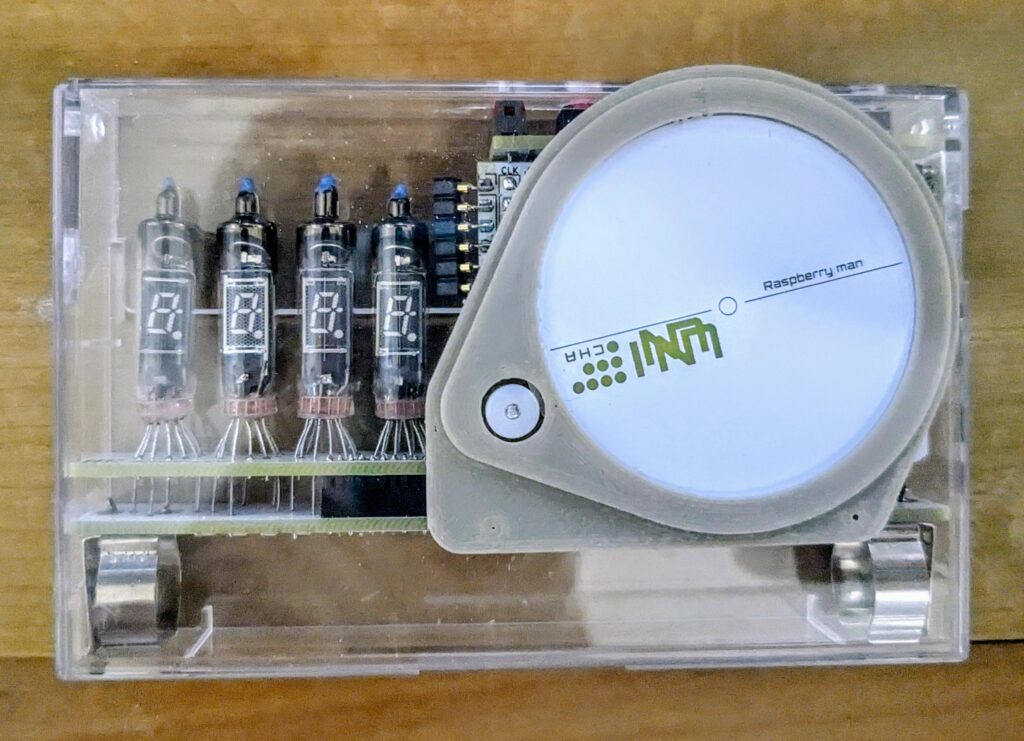
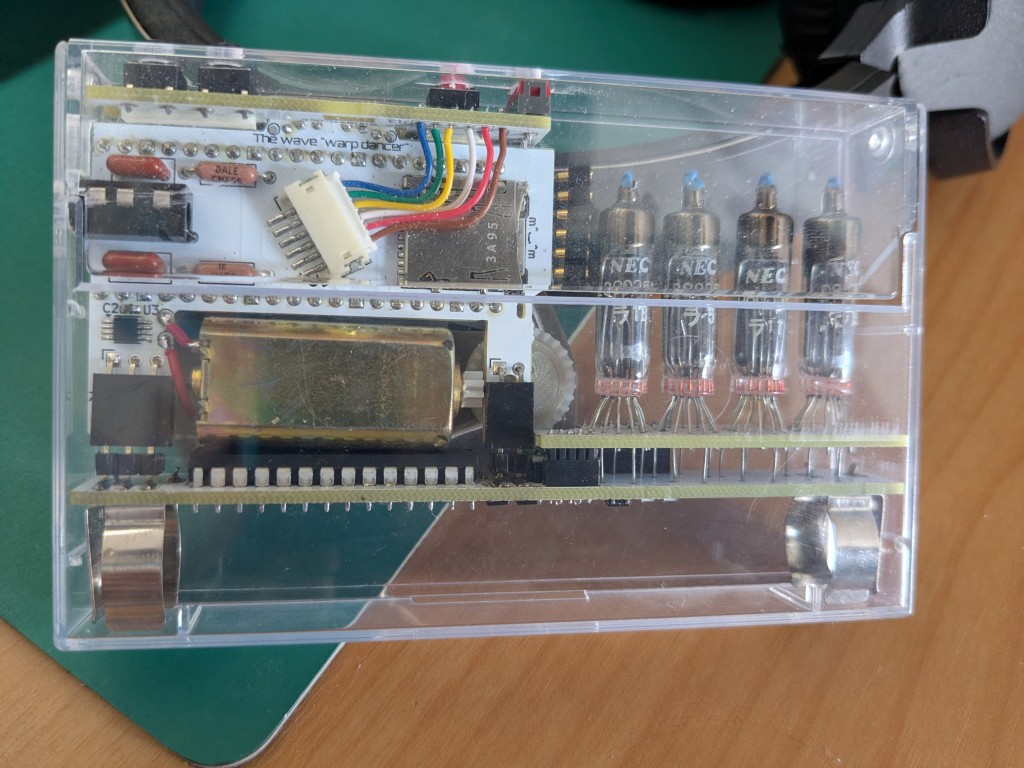
Features
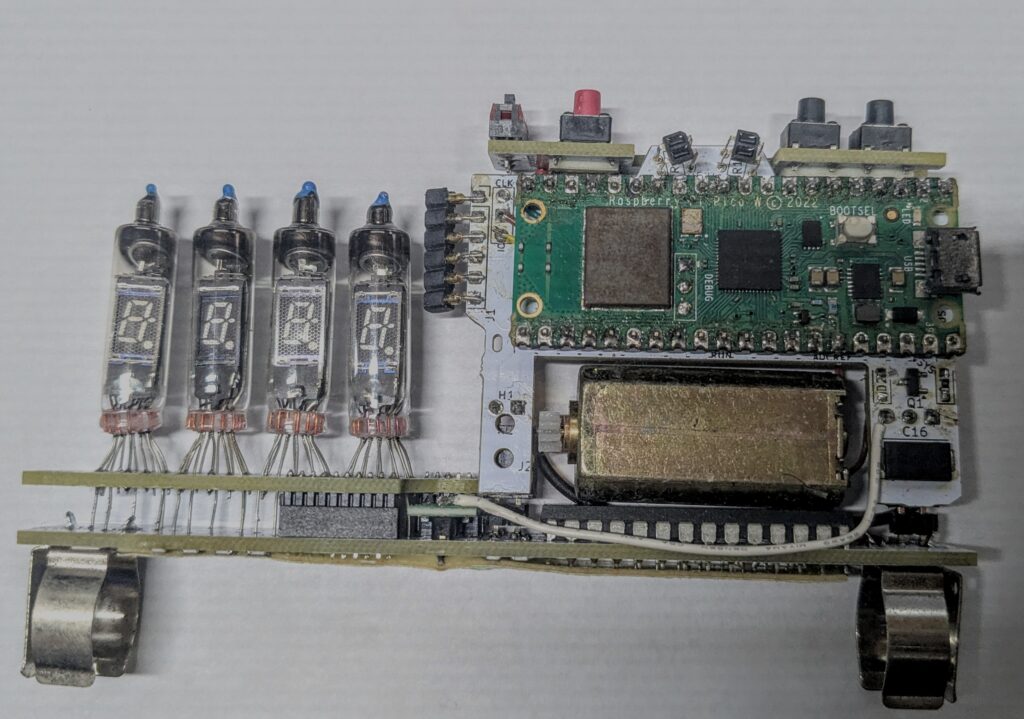
As the name suggests, Raspberry_man uses the Raspberry Pi Pico series. It is currently compatible with the Pico Pico2 or their W variants. Audio is sent from the Pico to the PCM5102 DAC via I2S and output directly through the headphone jack. Currently, audio files can only be imported via Micro SD card, but I plan to implement USB import functionality in the future, as well as web radio functionality using the WiFi/BT capabilities of the W variants.
The underside of the turntable features an optical encoder plate using silk screen printing, which sends signals to the Pico via a photoreflector. The display uses the NEC LD8035, which was adopted in Casio’s early portable calculator, the Casio Mini. Using a dynamic lighting method achieved miniaturization and power efficiency. The display is controlled by the MCP23017 IO expander. The main board and display board are separated, allowing each to be debugged independently.
History
Raspberry_man is the project I’m currently focusing my efforts on. Development began in 2023, and the first unit was completed in 2025.
Future Plans
Although it’s named Raspberry_man, after actually building Rev.1, we discovered that the Pico board occupies too much space on the PCB and also hinders the turntable’s rotation. Therefore, we are considering either switching to a smaller third-party board or changing to the ESP32 series. Doing this will free up more space on the PCB, allowing room for peripheral circuits to improve sound quality and accommodate more buttons. Additionally, I plan to improve the turntable’s rotation method and the mechanism supporting it. The current turntable has significant friction and mechanical noise, making it difficult to enjoy music comfortably while it’s spinning. I aim to make the rotation inaudible by adopting bearings for the rotation axis or using a motor capable of lower RPMs. Finally, power efficiency. The current version has some circuits that remain powered even when unused by the software. We believe adding circuits to turn these ON/OFF will significantly reduce power consumption.
Rev.2, incorporating these changes, is currently under development. If things go well, we hope to sell a small number somewhere.